Climbing the summit of Cotopaxi Volcano

Nature
The wow factor for nature - does it show nature at its best? Doesn't need to be the wildebeest migration or diving with hundreds of hammerheads. Rather make you pause as you realise just how awesome the natural world can be
9
Culture
How much does this experience showcase some of the better and finer things that us humans can offer? Sure, it can be ancient ruins and renaissance churches, but it can also be festivals or soaking up some of the great modern cities of the world
1
Fun factor/activity
Very simple - was it fun? This is usually linked in with doing some kind of activity - i mean, walking along some cliffs is nice, but paragliding from them, now that is fun. Its a vastly underrated factor in a truly great experience
8
Avoid the crowds
Big tour groups and being surrounded by loud fellow tourists can sap the life out of even the greatest of travel experiences. This score is to reflect just how much you can avoid this. But. . . The score also takes into account if the crowds actually add to the experience, such as with a party town or a bustling local market
10
World famous
How world famous is the experience?
5
unique
How hard is it to have a similar experience in other places round the world?
8
Overall TE Score
The overall travel experiences score:  fun factor + avoid the crowds + (best of nature or culture) + (best of world famous or unique). Then convert into a score out of 100
87 *What the scores mean and where do they come from
RANKING
How this travel experience ranks compared to all the other experiences on this site, based on the travel experience (te) score
10th/453
Top 5%
continent
South America
country
Ecuador
Length of time
1-2 days
Typical daily price
This gives you a rough idea of the daily price based on 2 people travelling where they can split costs like accommodation. It excludes travel there and back, and factors in inflation the numbers in brackets show the price range for the full time of the experience (so not necessarily daily). It is a range to reflect different budget vs higher end
$230 ($320-$550 in 2025 prices)
Time of year visited
February
Primary Tags
Click on any of the tags to see all travel experiences with the same tag
Wow Factor
The wow factor reflects just how much you’re likely to say “wow”. As there’s a lot of experiences in the world, and a lot of wows, i’ve gone with a simple ⭐️ ⭐️ ⭐️ ⭐️ ⭐️ to ⭐️ score, and a separate category for the truly "gash"
⭐⭐⭐⭐⭐

Summary

If you’re in Ecuador and keen for a challenge that doesn’t need a huge amount of preparation, climbing Cotopaxi is a great option as its mentally harder than technically hard.   1,000m / 3,280ft of elevation to climb up the volcano and glacier; 10 hours mainly in the dark with head torches, crampons, ropes and ice axes; -15˚C / 5˚F; and dealing with the altitude challenges of a volcano that reaches 5897m / 19,347ft.  Yep, challenge box ✅.


Some train for months for this.  But if you’re fit, already partially acclimatised, and determined, you can do this.  You’ll be rewarded (hopefully!) with world-class views across the valleys as far as Quito, an otherworldly experience through the glaciers and on the crater top and, of course, feeling pretty chuffed at making it to the top.  A real maximum Wow-factor experience.


View of the Cotopaxi volcano Crater after summiting from a 8 hour climb


In a nutshell:

  • A high-altitude climb to the summit of one of Ecuador’s most iconic volcanoes gets the highest wow score of Wow Wow Wow ⭐️⭐️⭐️.

  • Technically straightforward, but physically and mentally demanding.

  • Long night ascent on snow and ice, with duration of 9-10 hours and altitude of 5,500m+ the main challenges.

  • Achievable for fit hikers with basic snow skills and good acclimatisation.

  • A true summit experience without the length or complexity of major expeditions.

Table of Contents

Highlights of climbing Cotopaxi

Climbing Cotopaxi Volcano - #1 Catching the sunrise and the feeling of accomplishment when you reach the summit at 5,897m

#1 Catching the sunrise and the feeling of accomplishment when you reach the summit at 5,897m

Climbing Cotopaxi Volcano - #2 Passing through the beautiful ice structures of the glacier that represents the only way up to the summit

#2 Passing through the beautiful ice structures of the glacier that represents the only way up to the summit

Climbing Cotopaxi Volcano - #3 Seeing the crater itself. Smouldering and awe-inspiring

#3 Seeing the crater itself. Smouldering and awe-inspiring

Climbing Cotopaxi Volcano - #4 The views out across the valleys below. The twinkling lights in the evening as you make the ascent and the beautiful green colours of the valley as you make the way down in the morning

#4 The views out across the valleys below. The twinkling lights in the evening as you make the ascent and the beautiful green colours of the valley as you make the way down in the morning

Climbing Cotopaxi Volcano - #5 Spending a few days afterwards relaxing in the gorgeous Cotopaxi National Park

#5 Spending a few days afterwards relaxing in the gorgeous national park

Climbing Cotopaxi Volcano - #6 The challenge of the climb. Whilst it is "only" a 1,000m / 3,280ft climb, it has the added challenge of being cold and at altitude

#6 The challenge of the climb. Whilst it is "only" a 1,000m / 3,280ft climb, it has the added challenge of being cold and at altitude

Climbing Cotopaxi Volcano - #7 The gear! Getting a chance to give the crampons and ice axes a go!

#7 The gear! Getting a chance to give the crampons and ice axes a go!

#1 Tip – one climber, one guide


You must have a guide to summit Cotopaxi.  I mean, unless you’re a professional climber you’d be a lunatic not to have a guide! Your level of fitness and the weather all influence your likelihood of success in reaching the summit, but so does being reliant on others on a group tour.  Based on our guide’s view and a bit of basic research, the success rate for a climb is roughly 30%-40% i.e. of all people who attempt to summit only 30%-40% make it.  If someone in your group needs to go down, so does the guide and so do you.  So, considering the fantastic feeling of summiting and being met with views across what feels like all of Ecuador . . . vs the disappointment of having to head back early . . . it makes sense to remove that chance by being the only one in the group.


To give an idea of pricing, typically you’re looking at US$500-US$600 for a 1 person 1 guide summit, including all equipment.  For 2 people its US$320 per person.  And decreases from there.  Unless you have Sylvester Stallone from Cliffhanger as your buddy, pay the extra.


Climbing Cotopaxi Volcano - just after the Refuge and before the ice and glaciers start

Climbing Cotopaxi Volcano – just after the Refuge and before the ice and glaciers start


I recommend Tovar Expeditions as organised via the Hostal Tiana backpackers in Latacunga.  The guide, Julian, was simply wonderful – very experienced (he’d summited 692 times), very supportive and just a great guy. The rental equipment was first class and varied.  Have a look for availability Tavor Expeditions – Cotopaxi.

Rough Itinerary for the Climb

  • Day 1:
    • Meet your guide at your hotel / hostel in Latacunga around lunchtime to get your gear
    • Drive up in the afternoon through the national park and to the car park around 400m below the Jose Rivas refuge
    • Walk up to the refuge and sleep the night there until 11pm


  • Day 2
    • Wake at 11pm to start your accent
    • After around one hour you’ll reach the glacier to put on your crampons
    • Go through pain for 6 hours or so
    • Reach the summit around 6am to see the sunrise around 620am
    • Stay at the summit for 45mins or so for photos and to watch the sun rise
    • 2-3 hours to descend
    • Back at the refuge around 9am
    • Sleep (guide will want to sleep) for 2 hours or so
    • Walk back down to the carpark and head to your next destination


  • For 2 days or so, I would highly recommend staying somewhere in the national park (to recover more than anything!)


Expect it to be Tough!


Firstly, and you’ll be told this a few times, the whole experience is hard.   I was 35 when I did it, relatively fit, usually keen for a challenge, don’t mind the cold and had spent the past 2 weeks or so travelling at altitude, so from that point of view I was well set.  Then again, I’d never been above 5000m before, hadn’t really done any hiking in preparation, only decided I wanted to do the climb a couple of days before and had never used crampons etc. I’ve listed below some of the key factors that make the climb difficult.


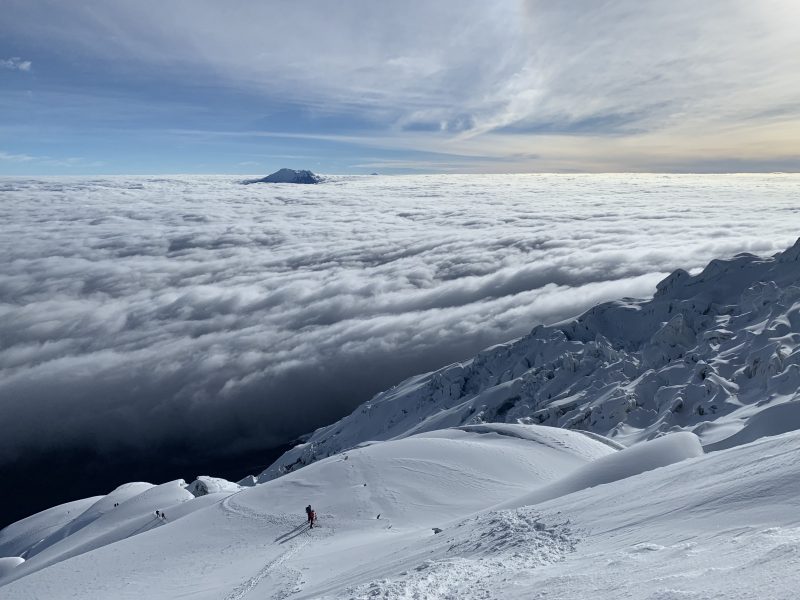
Climbing Cotopaxi Volcano - early morning view above the clouds and down the snow slopes

Early morning view above the clouds and down the snow slopes of Cotopaxi


1. It’s a long slog – whilst its “only” 1,000m / 3,280ft vertical at around 45 degree angle, it takes 6-7 hours for the uphill.

2. It’s cold – around -15˚C / 5˚F.

3. It’s dark – this is good and bad.  Good – you’re less likely to get vertigo at the crevasses you pass.  Bad – you’re reliant on your head torch if there is little moonlight.

4. You’ll be starting without much sleep. You go to bed around 7pm and everyone is up at 11pm. I didn’t really sleep much as was used to going to sleep way later and unfortunately had some erratic snorers next to me.  Nothing quite like falling asleep only to be woken up 10mins later for a 9-10 hour slog!

5. The altitude means less oxygen, so you’ll find yourself breathing deeply, going very slowly and needing far more rests.  I was shocked by just how tired I was towards the final third and now understand, genuinley, “one step at a time”.

6. The altitude sickness. Thankfully, I only had a banging headache and broad feeling of not being quite right. Others vomit or have to go down in the case of disorientation, lung issues etc.  Its not fun, and you’re pushing yourself quite hard unless fully acclimatised like the guides.  Its worth bearing in mind that the highest point you pass on the Inca Trail, which is synonymous with travellers sharing their high altitude stories, is 4,215m / 13,800ft.  Cotopaxi’s Refuge Camp where you start is already 4,800m / 15,750ft.

7. The way down – actually a bit harder than you’d think.  It takes 2-3 hours and, although you can slide down, your legs will start to tire quite quickly. I wasn’t really prepared for it, so it came as a bit of a surprise.

3 Tips I found helped with the Cotopaxi Ascent


1. Take your time – it’s not like normal hiking.  You will need to take rests and will be going at a very slow pace relative to low altitude walking.  I had a few people zip past me and similarly I zipped past them a few times.  We all got to the top for sunrise within around 30mins of each other.


2. Vary your technique – I couldn’t believe how slow I had to go at times so tried a few techniques to help. The constant one foot after the other was ok for the first bits, but higher up I found planting in the ice axe, taking two steps then stopping very briefly got me into a rhythm I could keep up for a while (I noticed most were doing this towards the top, including the guides).


3. What to bring – on top of the warm clothes and gear. I brought too much – 4 bars of chocolate, 2 bananas, m&ms, peanuts, 2.5 litres of water. Too much. If I did it again, I’d only take equivalent of two chocolate bars, 500ml bottle of water and a Powerade.  Also, bring some painkillers for the potential altitude sickness headaches.  They were fun.


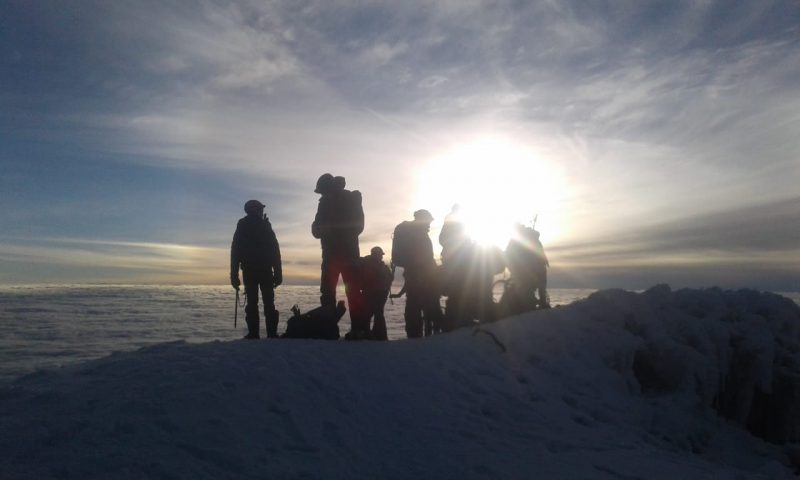
Cotopaxi Volcano - sunrise at the top with the mountaineers

Sunrise at the top

Extra Tips

The route – this will be decided by your guide and the conditions.  We took the original route rather than what is known as “The Heartbreaker”.  It was the only one available and not at all technical.  I had images of needing to climb ladders or cross bridges, but there is none of that (well, there is a less than 1 foot step over a crevasse but its more like a small hole).


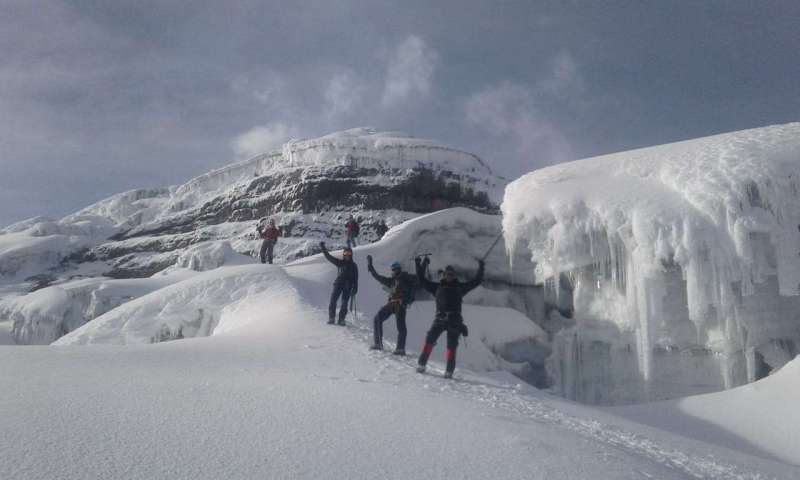
Just before the summit of Cotopaxi Volcano

Past the tough bits and just before the final summit of Cotopaxi


You won’t be wearing your hiking boots – they will provide boots the crampons can be added to. Like ski boots but a bit more flexible. Also, you’ll be provided with two layers of pants (inner and waterproof), probably 4 layers for upper body, gloves, balaclava, hat, helmet.


The refuge is quite nice – very friendly and lots of food / drinks. My girlfriend came along up to stay at the refuge and enjoyed it.


When to climb – the most reliable months to summit Cotopaxi are June to August, during Ecuador’s drier season, when weather windows are more stable and summit success rates are highest. December to January can also be good, but conditions are more variable and snowfall can complicate the climb. March to May are generally the least reliable months due to higher rainfall, increased cloud cover and poorer glacier conditions.  All that being said, the best bet, if flexible, is to check conditions closer to the time.  I climbed at the end of Feb and it was perfect.


Be sure to consider staying in the beautiful national park for a day or two afterwards.  Its a nice rest after the climbing, but also a great spot for walks and generally sitting gawping at the perfect cone of Cotopaxi.  We stayed for 2 nights at Hacienda Los Mortinos which was lovely, if a bit pricey.


Staying in Cotopaxi National Park - views of the volcano from Hacienda Los Mortinos

Views of Cotopaxi from the Hacienda Los Mortinos within the Cotopaxi National Park 


For preparation – the Quilatoa Loop only around an hour or so drive to the South West is a fantastic 2/3 days of hiking through mountain valleys like something from a Lord of the Rings movie and will give you time to acclimatise.  See the entry 3 days / 2 nights hiking the Quilatoa Loop for more details.


Finally – best of luck for those attempting it!

Experiences Nearby

The below map shows experiences nearby with a colour that reflect the Overall Score of those experiences

Score Detail

The scores you see above are really the point of this whole site, rather than just the individual travel review you're seeing above.  They fit into a much bigger summary of 20 years of travel, across 100+ countries, from dirt-poor backpacking to the luxury end, rushed weekends to months on the road.  Every one of the 500+ experiences have a "wow factor" score and a few other scores that add up to a more analytical Travel Experience (TE) score.  For more info, have a look at the About page for the travel philosophy that drives them.

But, more importantly, have a play with the map above and on the Home page to see which of these experiences rank as really Maximum Wow-factor all the way down to the proper "Gash".

Leave a Reply

Your email address will not be published. Required fields are marked *