There are so many sites out there that offer huge amounts of detail on the Inca Trail route and exactly what you’ll need for the trek (Dusty Roads for example do a great one, link here), so I won’t repeat what you can find elsewhere. Instead I’ll just focus on the key tips we found:
Choosing the right company
Who to go with is obviously super important (you cannot walk the Inca Trail on your own). We went with Inca Trail Reservations (Inca Trail Reservations) who were recommended to us by a few people and had very good ratings in their various online reviews. Total came to US$670 per person – US$250 up front, USD395 remaining, US$25 for sleeping bags (2019 prices), which included all the permits, entry for Machu Picchu, gear for the hikes, guides, food etc etc. Plus you should probably bring around US$70 for tips for your guides and porters – they earn it.
Also included some really useful pieces like pick up from the airport and just managing the whole process beforehand for you. The food was surprisingly good considering the porters and teams of donkeys have to carry everything for the 4 days. Would recommend.

End of Day 3 with Inca Trail Reservations
Give yourself 2-3 days in Cusco before starting the Inca Trail
I’d strongly suggest taking 2-3 days after landing in Cusco and before starting the Inca Trail to:
1. Acclimatise to the altitude – by the second day of the Inca Trail you’re passing the high point of Dead Woman’s Pass at 4200m / 13,780 feet. That’s high enough to give you altitude sickness (generally feeling a bit like a bad hangover, which isn’t fun). You can do various things to help, such as take pills (we took Acetazolamide and felt like it helped), drink coca tea, take pain killers to help with the headache etc, but the best way is simply to give your body time to get used to the altitude. Cusco is 3400m / 11200ft, which is enough over 2/3 days to really make a difference.
2. See the world-class historical sites near Cusco. Its not all about the Inca Trail and Machu Picchu. The sites in and around Cusco itself are totally worth it (see here for details on how to do this and tips) and driving through the Sacred Valley is a Wow ⭐️ on its own ( see Driving through the Sacred Valley for tips). Doing these will also give you some of the context to the Inca before you hit their jewel in the crown, Machu Picchu when you finish the trail.
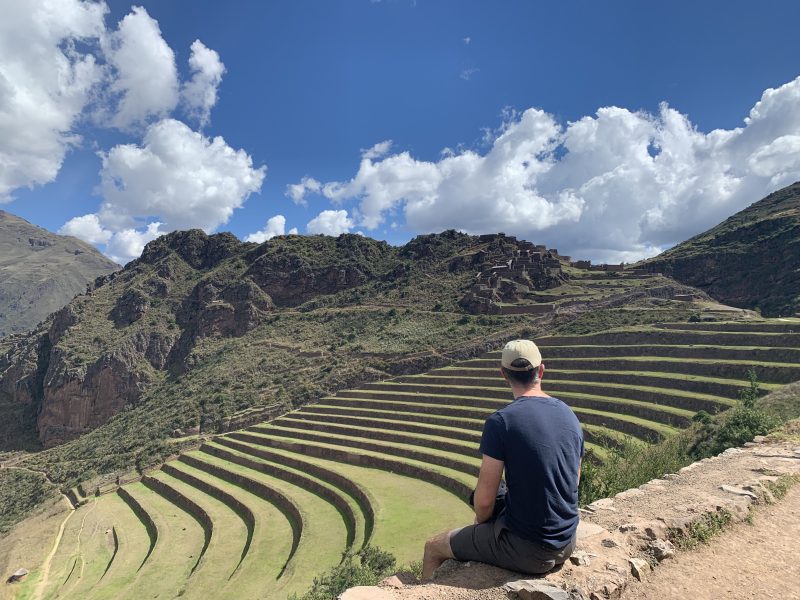
Marvelling at the Inca perfection at the likes of Pisac in the Sacred Valley that you will pass through on your way to the Inca Trail
Level of fitness
The whole Inca Trail is 43km spread over the 3.5 days, but of course this involves a lot of ups and downs, plus the altitude makes the passes harder. To give an idea, over the 3.5 days my iPhone showed 84,000 steps and 620 flights climbed, so its definitely a challenge. I’d say though that as long as you have a moderate level of fitness that you can do the Inca Trail. A few reasons for this:
1. The guides are actually very good at both motivating you and assessing your level of fitness. Very early they’ll potentially split the group into those who will go quicker and those that will need more rests.
2. For those who are bit worried if they’ll be able to walk the full distance to the next campsite, the porters will give you the option to wake up super early to give yourself more time.
3. There is the option of giving yourself more days through a 5 day / 4 night hiking option.
4. The surrounding scenery really is motivating, and once you’re over Dead Woman’s Pass on the second day, its fairly straightforward from there.

All Trails app route for the Inca Trail
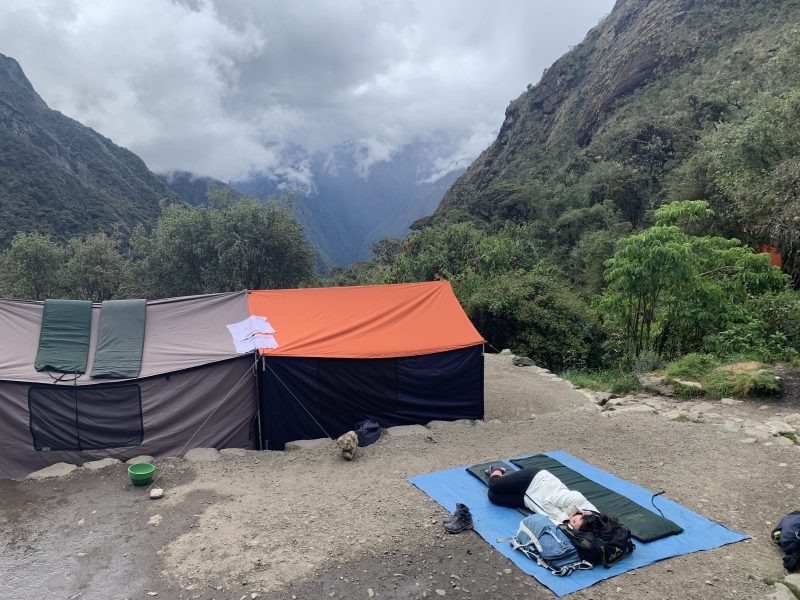
Taking a nap after finishing Day 2 early, just after passing Dead Woman’s Pass
Bring as little stuff as possible
You’ll get told this repeatedly. The porters are only allowed to carry a certain weight of your stuff (6kg / 13lbs), so the rest will be on you. My suggestion:
- Bring clothes for cold, hot, rain, and sun – so, one pair of worn-in hiking boots / hiking trainers (you want grip), waterproofs, lightweight hiking clothes – everyone has their preferences, but a good rule is to combine synthetic fibers and layering.
- Basic toiletries – including toilet paper.
- Something for blisters – don’t faff about with band-aids / plasters – go for something like Compeed which is far more comprehensive for blisters.
- A power bank for 3-4 phone charges – there are sometimes places to charge along the way, but they are hit and miss.
You can leave the remainder of your stuff with the company in Cusco.
Showers are very basic
I always feel like I need a shower at least once a day and am prepared to face up to glacial cold water to get one, so I suppose my threshold for acceptable is higher. But, be prepared for the showers to either be bloody cold, or warm but super stinky and not be available each camp site.
No Internet
A nightmare or a dream depending on how you look at it! We found a couple of high spots that had some mobile / cell reception, but don’t count on them.
You don’t have to start your tour from Cusco
We actually spent 4 days exploring Cusco and the Sacred Valley and were picked up from a hotel near Ollantaytambo. The benefits of this is that you don’t have to keep returning to Cusco from your day trips; you get to stay in areas that see a significant drop off in tourist numbers; and because the Ollantaytambo area is 2 hours or so closer to the start of the Inca Trail than Cusco, it gives you a bit more of a lie in on the first day. We stayed at a gorgeous hotel in the valley that leads up to Machu Picchu called Del Pilar Ollantaytambo Hotel, and would really recommend.
For how the Inca Trail fits into a Peru trip
Peru is a sensational country for travelling. Lima is one of the world’s food capitals, the Colca Canyon hike is through the second deepest in the world (twice as deep as the Grand Canyon), Arequipa is one of the best old towns in the world, and of course this all ties in with the Inca Trail. For an itinerary for 2/3 weeks in Peru, the highlights and general tips, see the individual travel entry – 2/3 weeks for the highlights of Peru.

Views of the Colca Canyon, which you can hike as part of a 2 week itinerary for Peru which includes the Inca Trail




