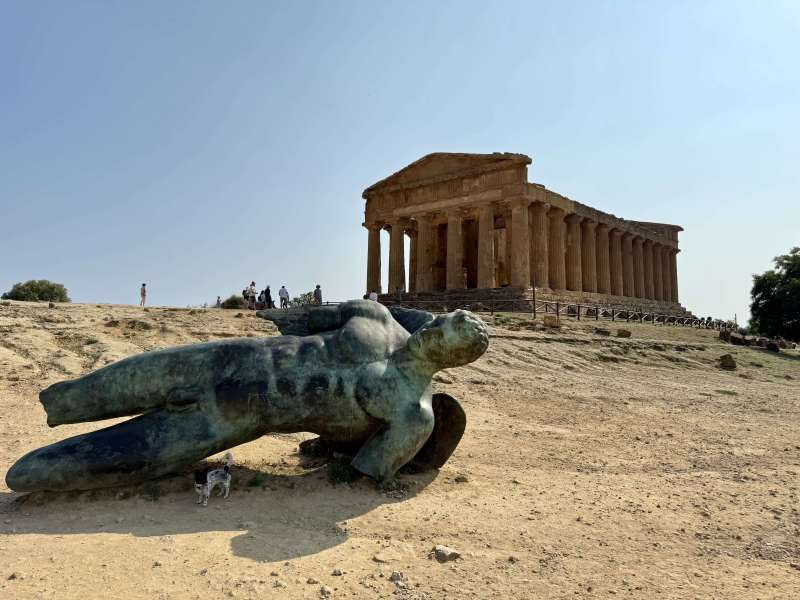
Agrigento’s Valley of the Temples

Nature
The wow factor for nature - does it show nature at its best? Doesn't need to be the wildebeest migration or diving with hundreds of hammerheads. Rather make you pause as you realise just how awesome the natural world can be
6
Culture
How much does this experience showcase some of the better and finer things that us humans can offer? Sure, it can be ancient ruins and renaissance churches, but it can also be festivals or soaking up some of the great modern cities of the world
10
Fun factor/activity
Very simple - was it fun? This is usually linked in with doing some kind of activity - i mean, walking along some cliffs is nice, but paragliding from them, now that is fun. Its a vastly underrated factor in a truly great experience
6
Avoid the crowds
Big tour groups and being surrounded by loud fellow tourists can sap the life out of even the greatest of travel experiences. This score is to reflect just how much you can avoid this. But. . . The score also takes into account if the crowds actually add to the experience, such as with a party town or a bustling local market
6
World famous
How world famous is the experience?
7
unique
How hard is it to have a similar experience in other places round the world?
8
Overall TE Score
The overall travel experiences score:  fun factor + avoid the crowds + (best of nature or culture) + (best of world famous or unique). Then convert into a score out of 100
75 *What the scores mean and where do they come from
RANKING
How this travel experience ranks compared to all the other experiences on this site, based on the travel experience (te) score
101st/457
Top 30%
continent
Europe
country
Italy
Length of time
1 day or less
Typical daily price
This gives you a rough idea of the daily price based on 2 people travelling where they can split costs like accommodation. It excludes travel there and back, and factors in inflation the numbers in brackets show the price range for the full time of the experience (so not necessarily daily). It is a range to reflect different budget vs higher end
$20 (typically $20 - $20)
Time of year visited
June
Primary Tags
Click on any of the tags to see all travel experiences with the same tag
All Tags
Wow Factor
Two scores: first is the wow factor which ranges from ⭐️ ⭐️ ⭐️ ⭐️ ⭐️ to ⭐️, and a separate category for the truly "gash". The second is the more analytical travel experience score, which considers 6 varied criteria to give an overall score out of 100.
⭐⭐⭐

Summary

Agrigento’s Valley of the Temples is an astonishingly well preserved Ancient Greek city (originally called Akragas) in Sicily.  One of the best preserved in the Mediterranean and perhaps in the world.  To give a few facts for context and to back this up:

✅ It was founded back in 580BC, which is centuries before the Romans got here.

✅ It was described by the poet Pindar as the most beautiful city ever built by mortals.

✅ It is often cited as the best example of Ancient Greek ruins anywhere . . . including Greece.

✅ It is so well preserved and impressive that UNESCO use it’s the Temple of Concordia for their UNESCO World Heritage logo!

Even for non-history nuts, its totally worth the visit.  Everyone can get templed out and some ancient sites need a lot of imagination, but this one quickly comes to life.  The whole thing unfolds along a long, straight ridge with uninterrupted views and temples lining the route with space between. And yes, so chilled we even brought the dogs, who trotted happily between 2,500-year-old columns like they owned the place.

Considering the significance and how easy it is to experience, don’t miss it on a Sicily itinerary.

5 Tips for Agrigento’s Valley of the Temples

#1 Doesn’t need much planning – its a long straight layout and just walking through it is the highlight – most ancient sites sprawl or feel fragmented. Agrigento is the opposite – clear, straight ridge with temples lined up along the way.  It makes the whole thing incredibly easy to follow and surprisingly immersive.

Agrigento's Valley of the Temples - map of site

The Map of Agrigento showing how linear the route is


#2 Temple of Concordia (UNESCO logo) is the focus – the star of the show, and unbelievably well preserved. This is the temple that inspired the UNESCO World Heritage logo, and when you see it in person, it makes sense. Perfect proportions, stunning location.

Agrigento's Valley of the Temples - Temple of Concordia

Temple of Concordia


#3 Aim for late afternoon magic – we originally turned up midday (in June) to find a heap of tour buses outside, so figured we’d go for a lazy late lunch. Lunch was full of people leaving for the site, so we felt like we avoided the main day crowds.  Got there for 4pm and felt like we had it, largely, to ourselves and had the golden colours as sun was getting late in the day.


#4 Do Lunch in Il Re di Girgenti – cracking lunch spot less than 5mins drive.  Great food, lovely terrace, and a brilliant view straight across to the temples.  Few wines at lunch, couple of coffees, prefect pre-visit stop.


#5 Some practicalities.  How long you need – 2–3 hours including plenty of photo stops. You could take longer if you’re into your ancient history.   Tickets – easy to buy on-site or ahead of time, queue moves quickly. Parking:
Straightforward. Plenty of space at both ends of the site.


5 Few History Facts for Agrigento’s Valley of the Temples

1. Greek, not Roman – Agrigento (ancient Akragas) was founded by Greek colonists from Gela and Rhodes around 580 BC, long before the Roman Empire existed.  It became one of the richest and most powerful Greek cities in the Mediterranean.

2. Built during the Golden Age of Greece and Athens – Most of the temples, including Concordia, Juno, and Heracles, were constructed in the 5th century BC, the same era as the Parthenon in Athens.  Peak Classical Greece.

3. The city had over 200,000 people – at its height, Akragas may have had 200,000 residents, huge for the ancient world – making it one of the largest Greek cities anywhere.

4. Conquered repeatedly – Agrigento was taken by just about everyone.  Carthaginians (406 BC), Romans (210 BC), Byzantines, Arabs (who renamed it “Kerkent”), Normans . . . and now us Tourists.

5. The Temple of Zeus was daft big – it was was one of the largest temples ever built at over 112m / 370ft long, 56m / 180ft wide (so area of c.6,400 square metres / 70,000 square feet) and 30m tall.  For context, at the time this dwarfed the Parthenon (2150 sqm) or Temple of Olympian Zeus (4,800 sqm).  The Temple of Artemis in Ephesus (an ancient Wonder of the World) was 6,300 sqm.  Only the great Egyptian temple complexes or the colossal Persian capitals rivalled it – and those were royal centres, not just single temples.  Should arguably have been 8 Wonders of the Ancient World.

Experiences Nearby

Wow Factor Score Two scores: first is the wow factor which ranges from ⭐️ ⭐️ ⭐️ ⭐️ ⭐️ to ⭐️, and a separate category for the truly "gash". The second is the more analytical travel experience score, which considers 6 varied criteria to give an overall score out of 100. LowHigh
  • Elite, unmissable
  • World-class, downsides
  • Meets the Wow Factor
  • Worth it
  • Meh
  • Gash

Score Detail

The scores above are the real point of this site.

Over 20+ years and 100+ countries, I’ve tried to rank the world’s best travel experiences - from genuinely mind-blowing ⭐⭐⭐⭐⭐ to the properly gash.

Every one of the 500+ places on this site has both a Wow Factor rating and a more analytical Travel Experience (TE) score based on the things that actually make travel memorable.

If you're curious about the thinking behind it, head to the About page.

Otherwise, explore the map above or on the Home page and see which places truly deliver maximum wow.

Leave a Reply

Your email address will not be published. Required fields are marked *

Get the Wow Before Everyone Else

Join the newsletter for new travel experiences, fresh rankings, personal notes, and stories from the archive — sent only when there’s something worth sharing.

Loading